
Using AI to produce reporting and analysis makes obvious sense to me. I also expect it to change hiring and headcount plans, both in data teams and more broadly.
The harder question is whether those tools are being used by data specialists, or whether the wider organisation can take on their work without that specialist support.
Making that decision means understanding what your data team contributes to business strategy. That’s a cultural and strategic discussion, and I think many organisations will find it harder than deciding which tasks to automate.
Caveat: I’m writing this in October 2026, and at the current pace of change, this will likely be obsolete by Jan 2027 🤷.
A list of tasks isn’t a description of a team#
In many organisations there’s a real disagreement about what data teams are actually for. Without first aligning with the rest of the organisation on what you want to achieve with respect to data, you will not be able to align on how to serve those needs using AI or using humans.
While most people see the output (the tasks) of a data team, through dashboards, reports or analysis - I think that’s a deceptive place to start when considering the team itself. That’s mainly because it doesn’t distinguish between having data people using AI extensively to produce those outputs, or shedding the data people entirely and having the wider organisation produce those outputs themselves.
A more practical starting point is to think about responsibilities.
To draw on the example of software engineering, where software engineering teams are using AI extensively, the teams remain because those people are still responsible for uptime, reliability, and maintenance of the application as built.
What that means for data teams is that even if the external artefacts, like reports and dashboards, are still generated by AI, there are ongoing responsibilities for things like the quality and robustness of that data, which still remain. It’s not necessarily true that all of those responsibilities need to sit with a “data team”, but organisations do need to ensure they’re covered somewhere.
What responsibilities do we need to make sure are covered?#
In Growing Business Analytics on a Shoestring — Part 2, I described using the Carruthers & Jackson Data Maturity Model at tails.com. It gave people a shared way to discuss how the organisation used data, and to agree what needed to change.
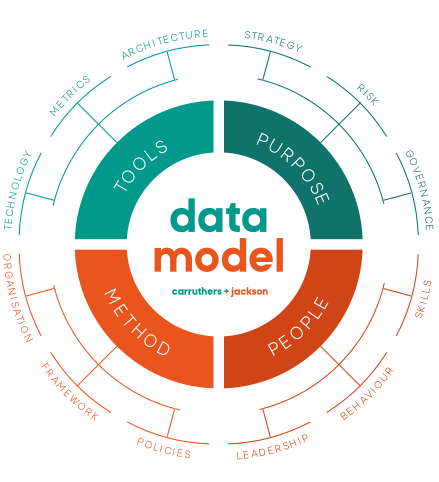
This model still holds today, and is a good starting point for this discussion internally. A maturity assessment makes space for questions about culture, communication and strategy alongside the technical work. The useful output is the discussion and the resulting plan, rather than a score to put in a slide deck.
For each area, ask: what outcome do we need, who owns it today, and who will own it under the proposed setup?
- Who decides which business problems the data work should serve?
- Who maintains definitions, quality and appropriate access?
- Who helps people interpret uncertain or conflicting answers?
- Who notices when the analysis isn’t improving decisions?
- Who has the time and authority to put things right when mistakes happen?
If the answer is “the AI”, keep going until you can name the person responsible for accepting its work and dealing with the consequences.
That doesn’t make the data team responsible for every decision someone makes with data. Data specialists remain responsible for the shared foundations they maintain. People producing analysis need to check their work, and business leaders remain accountable for the decisions they make using it.
Change the team around the responsibilities#
This isn’t an argument for preserving every existing role or process. AI may make a different team structure possible, and some work may no longer need a dedicated person at all.
Some segments of the framework, like risk or governance could be taken up by teams like finance who already have processes for that. Skills and organisation could be taken up by HR functions given the right specialisms within that team. Technology choices can be absorbed by engineering functions in some organisations.
The two responsibilities that I find hardest to move, and where data teams typically have an important role, are:
- Metrics: who is responsible for deciding how your organisation is measured? Not just at a high level like “we should measure revenue”, but at a very precise, specific level: When is revenue counted? Do refunded orders count? Are we looking at invoiced amounts or cash received, and what should we do when they tell different stories? Finance should own accounting policy, and business owners need to agree the definitions relevant to their work. The data team’s role is to help make those definitions explicit, consistent and correctly implemented across the organisation. Teams have incentives to choose measures that favour their goals; someone needs to help them agree a common playing field rather than everyone marking their own homework.
- Frameworks: how do we use data to make decisions? In the face of competing versions of the truth, statistical uncertainty and ambiguous priorities - how should individuals and teams use data to move in a consistent, evidence-based direction? A really good data leader or senior data professional provides a wise guide through these kinds of decisions as an advisor in a way that AI doesn’t currently fulfil.
So do I need them?#
tl;dr: If your team right now truly is just a dashboard team, you may not need a separate team to produce those outputs. But only once the continuing responsibilities have named owners elsewhere: definitions, quality, access, reliability and helping people make sense of the results.
The real purpose of a data team was never just to make the graphs and charts, it was trust. Trusted, verified and reliable guidance through ambiguous and conflicting data. Your organisation still needs that. If your current team isn’t providing it, changing the team might be the right answer - but automating its visible tasks hasn’t removed the need.
The same distinction applies to the tools: does BI still make sense when Claude can make dashboards? Making the charts is only one part of what you were paying for.